IOS

DOJ Threatens To Seize iOS Source Code (idownloadblog.com) 596

An anonymous reader writes from an article posted on iDownloadBlog: The DoJ is demanding that Apple create a special version of iOS with removed security features that would permit the FBI to run brute-force passcode attempts on the San Bernardino shooter's iPhone 5c. Meanwhile, President Barack Obama has made public where he stands on the Apple vs. FBI case, which has quickly become a heated national debate. In the court papers, DoJ calls Apple's rhetoric in the San Bernardino standoff as "false" and "corrosive" because the Cupertino firm dared suggest that the FBI's court order could lead to a "police state." Footnote Nine of DoJ's filing reads:

"For the reasons discussed above, the FBI cannot itself modify the software on the San Bernardino shooter's iPhone without access to the source code and Apple's private electronic signature. The government did not seek to compel Apple to turn those over because it believed such a request would be less palatable to Apple. If Apple would prefer that course, however, that may provide an alternative that requires less labor by Apple programmers."

As Fortune's Philip-Elmer DeWitt rightfully pointed out, that's a classic police threat. "We can do this [the] easy way or the hard way. Give us the little thing we're asking for -- a way to bypass your security software -- or we'll take [the] whole thing: your crown jewels and the royal seal too," DeWitt wrote. "With Apple's source code, the FBI could, in theory, create its own version of iOS with the security features stripped out. Stamped with Apple's electronic signature, the Bureau's versions of iOS could pass for the real thing," he added.

Cellphones

LG Releases First Smartphone With DAB+ Chip (thestack.com) 53

An anonymous reader writes: LG have released the first smartphone with built-in DAB+ circuitry,allowing users to listen to digital radio without consuming mobile data bandwidth. The LG Stylus 2 will initially be released in the United Kingdom, Australia, Germany, Norway, Belgium, Italy and the Netherlands (perhaps not coincidentally these are among the highest-rate adopters of DAB/DAB+). Patchy coverage and often-poor bitrates have hindered the take-up of DAB/+, which has been in development since the early 1980s, and it's hoped that the shift from the motoring to the smartphone space will alleviate some of the coverage problems that users experienced with the push to DAB-based car radios. No benchmarks on power consumption of the integrated DAB+ circuitry is currently available.
Government

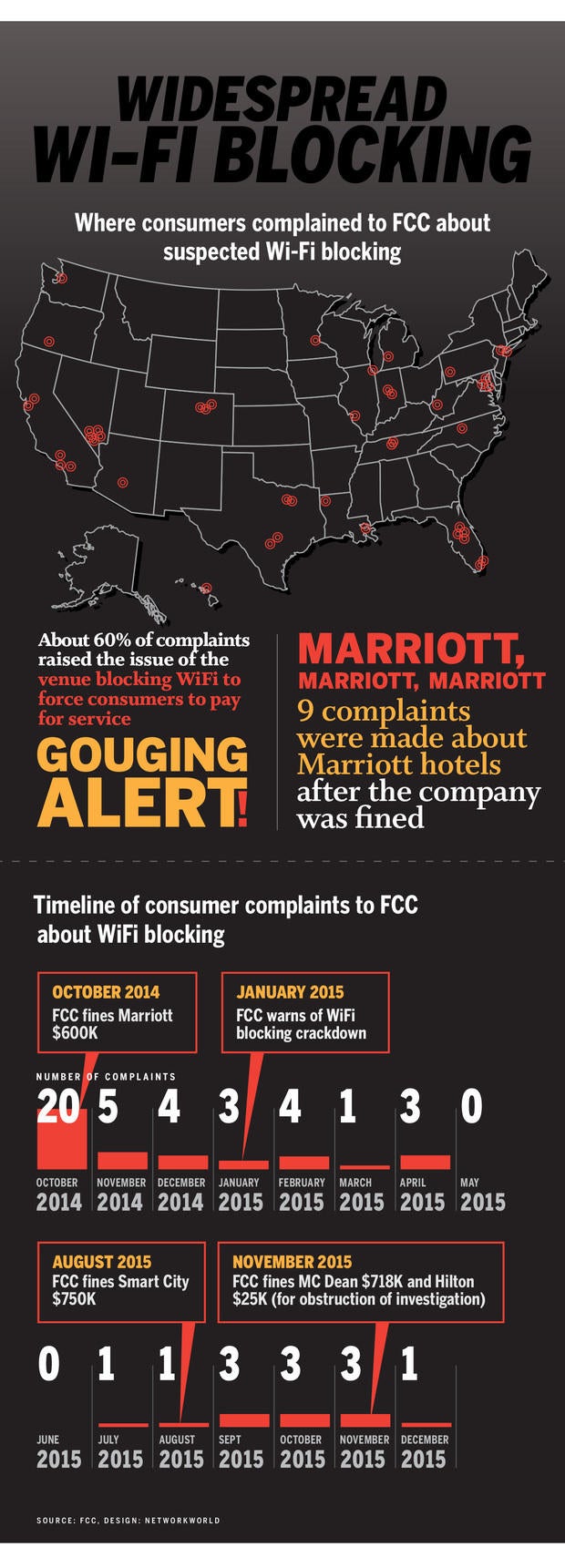
Wi-Fi Hotspot Blocking Persists Despite FCC Crackdown (networkworld.com) 85

An anonymous reader writes: An examination of consumer complaints to the FCC over the past year and a half shows that the practice of Wi-Fi hotspot device blocking continues even though the agency has slapped organizations such as Marriott and Hilton more than $2 million in total for doing this. Venues argue they need to block hotspots for security reasons, but the FCC and consumers say the organizations are doing this to force people to pay for pricey Internet access.
"Consumers who purchase cellular data plans should be able to use them without fear that their personal Internet connection will be blocked by their hotel or conference center," FCC Enforcement Bureau chief Travis LeBlanc said in a statement. "It is unacceptable for any hotel to intentionally disable personal hotspots while also charging consumers and small businesses high fees to use the hotel's own Wi-Fi network. This practice puts consumers in the untenable position of either paying twice for the same service or forgoing Internet access altogether." Consumers have filed many complaints about Wi-Fi hotspot blocking to the FCC.
Open Source

TP-Link Blocks Open Source Router Firmware To Comply With FCC Rules 36

An anonymous reader points to an official announcement made by TP-Link, which confirms a report from last month that it is blocking open source firmware: The FCC requires all manufacturers to prevent users from having any direct ability to change RF parameters (frequency limits, output power, country codes, etc.) In order to keep our products compliant with these implemented regulations, TP-LINK is distributing devices that feature country-specific firmware. Devices sold in the United States will have firmware and wireless settings that ensure compliance with local laws and regulations related to transmission power. As a result of these necessary changes, users are not able to flash the current generation of open-source, third-party firmware. We are excited to see the creative ways members of the open-source community update the new firmware to meet their needs. However, TP-LINK does not offer any guarantees or technical support for customers attempting to flash any third-party firmware to their devices. Don't lose all your hopes yet. Developer Sebastian Gottschall, who works on DD-WRT Linux-based firmware, believes that TP-Link hasn't blocked third-party firmware. He adds, "Just the firmware header has been a little bit changed and a region code has been added. This has been introduced in September 2015. DD-WRT for instance does still provide compatible images... in fact it's no lock." Furthermore, Cisco insists that FCC's existing or proposed rules doesn't limit or eliminate the ability of a developer to use open source software.
Iphone

Obama: Government Can't Let Smartphones Be 'Black Boxes' (bloomberg.com) 546

JoeyRox writes: President Obama said Friday that smartphones -- like the iPhone the FBI is trying to force Apple to help it hack -- can't be allowed to be "black boxes," inaccessible to the government. He believes technology companies should work with the government on encryption rather than leaving the issue for Congress to decide. He went on to say, "If your argument is strong encryption no matter what, and we can and should create black boxes, that I think does not strike the kind of balance we have lived with for 200, 300 years, and it's fetishizing our phones above every other value." Obama's appearance on Friday at the event known as SXSW, the first by a sitting president, comes as the FBI tries to force Apple to help investigators access an iPhone used by one of the assailants in December's deadly San Bernardino, California, terror attack. "The question we now have to ask is, if technologically it is possible to make an impenetrable device or system, where the encryption is so strong there's no key, there's no door at all, then how do we apprehend the child pornographer? How do we solve or disrupt a terrorist plot?" Obama said. "If in fact you can't crack that at all, government can't get in, then everybody's walking around with a Swiss bank account in their pocket." He said compromise is possible and the technology industry must help design it.
IOS

Apple Might Be Forced to Hand Over iOS Source Code to the FBI (theguardian.com) 273

Bruce66423 writes: In its latest filing, the FBI implies that, if the burden on Apple programmers of their alternative approach is too great, then Apple should release the whole source code to the FBI to allow them to do the work, quoting the precedent of the Lavabit confrontation. Clearly it is time for Apple to move offshore!? To recall, Lavabit abruptly shut down in 2013 when the FBI attempted to get the company to hand over the encryption keys for its secure email service. While the current situation seems to put Apple in the same ballpark as Lavabit, what gives the Cupertino-giant company an advantage is the immense support it is receiving from other Silicon Valley companies and personnel. Many believe that the FBI doesn't really need Apple's help in unlocking the iPhone. Reports claim that the iPhone in question already has a "backdoor" which could allow the government-backed institution to access the data on the smartphone. Other widely reported theories include cracking the iPhone and manipulating the innards to trick the system into spilling out all the information. One proposed method, which requires the phone's NAND flash chip to be taken out, may not work, though. Daniel Kahn Gillmor, a technology fellow with the ACLU's Speech, Privacy and Technology Project, pointed out the risks in playing with flash memory. He said that an error in removing the memory could make the data unreadable forever.
Communications

Chicagoan Arrested For Using Cell-phone Jammer To Make Subway Commute Tolerable (chicagotribune.com) 518

McGruber writes with this story from the Chicago Tribune: Last Fall, certified public accountant Dennis Nicholl boarded a Chicago subway train while carrying a plastic bag of Old Style beer. Nicholl popped open a beer and looked around the car, scowling as he saw another rider talking on a cellphone. He pulled out a black device from his pocket and switched it on. Commuters who had been talking on their phones went silent, checking their screens for the source of their dropped calls. On Tuesday, undercover officers arrested Nicholl. Cook County prosecutors and Chicago police allege he created his own personal 'quiet car' on the subway by using an illegal device he imported from China. He was charged with unlawful interference with a public utility, a felony. This is not the first time Nicholl has been charged with jamming cell calls. He pleaded guilty to a misdemeanor charge in June 2009, according to court records. He was placed under court supervision for a year, and his equipment was confiscated and destroyed.
Iphone

Apple Announces 'Let Us Loop You In' Event For March 21st (theverge.com) 66

An anonymous reader writes: The official Apple Events page has been updated in advance of the newly announced media event. Invitations were sent out earlier Thursday inviting members of the press to "let us loop you in." The event will be streamed using Apple's HTTP Live Streaming technology and will require an iPhone, iPad or iPod Touch running iOS 7.0 or later. The company is expected to announce a new, smaller iPhone SE, that will be the same size as the iPhone 5 but with improved specs like a A9 processor and 8-megapixel rear camera. In addition, Apple is expected to announce a new, smaller iPad Pro. It is rumored to feature a 9.7" display and a Smart Connector to support Smart Keyboard -- it may even be compatible with the Apple Pencil. We can expect some kind of update for the Apple Watch, most likely new Apple Watch bands. A black version of the Milanese Loop may be in the works to match the Space Black Apple Watch. Of course, Apple will talk encryption as the event is scheduled one day before the next hearing between Apple and the FBI on March 22. Apple may surprise us with new MacBooks or OS X updates but we will most likely have to wait until Apple's developer conference in June.
Power

Apple Executive Confirms: Manually Quitting Apps Doesn't Improve Battery Life (bgr.com) 151

An anonymous reader writes: Apple software engineering VP Craig Federighi recently dispelled one of the more long-standing myths about iPhone battery life. In short, if you spend a few minutes every day double clicking the iPhone home button and manually closing up applications in an effort to maintain battery life, you're wasting your time. The reality is that the applications you see upon opening up the multitasking pane are actually nothing more than static images intended to represent a list of your most recently used applications. Apple support documents have indicated, "generally, there's no need to force an app to close unless it's unresponsive." Apple support docs further explain: "After you switch to a different app, some apps run for a short period of time before they're set to a suspended state. Apps that are in a suspended state aren't actively in use, open, or taking up system resources."
Cellphones

Galaxy S7 vs iPhone 6S: Samsung Has the Upper-Hand, For Now (hothardware.com) 131

MojoKid writes: To look at Samsung's new Galaxy S7 and S7 Edge smartphones, on the surface, one might mistake them for only a modest uplift of bells and whistles, and perhaps a light rebuffing of the phone's design language. However, one of the primary new features of the US-targeted Samsung Galaxy S7 is its underlying power plant — Qualcomm's Snapdragon 820 system-on-a-chip (SoC). The Snapdragon 820 is based on Qualcomm's new, custom ARM-based core architecture called Kyro. Kyro marks an evolution beyond Qualcomm's venerable Krait core architecture that the company claims offers 2X the performance and power efficiency of their previous-gen Snapdragon 810. In addition, the quad-core Snapdragon 820 has a beefed-up Adreno 530 graphics engine on board as well. In performance testing versus Apple's potent A9 platform in the iPhone 6S Plus, Samsung's Galaxy S7 with the Snapdragon 820 generally outpaces the iPhone in multithreaded performance as well as graphics. The Apple A9 still does a lot of work with just two cores, but overall it looks as though Qualcomm has a highly-competitive SoC and Samsung put it to good use.
Iphone

Snowden: FBI's Claim It Can't Unlock The San Bernardino iPhone Is 'Bullshit' (theguardian.com) 242

An anonymous reader writes: Edward Snowden, the whistleblower whose NSA revelations sparked a debate on mass surveillance, has waded into the arguments over the FBI's attempt to force Apple to help it unlock the iPhone 5C of one of the San Bernardino shooters. The FBI says that only Apple can deactivate certain passcode protections on the iPhone, which will allow law enforcement to guess the passcode by using brute-force. Talking via video link from Moscow to the Common Cause Blueprint for a Great Democracy conference, Snowden said: "The FBI says Apple has the 'exclusive technical means' to unlock the phone. Respectfully, that's bullshit." Snowden then went on to tweet his support for an American Civil Liberties Union report saying that the FBI's claims in the case are fraudulent. Apple's clash with the FBI comes to a head in California this month when the two will meet in federal court to debate whether the smartphone manufacturer should be required to weaken security settings on the iPhone of the shooter.
Transportation

Hacking Internet-Connected Trucks and Buses 31

An anonymous reader writes: Among the things one can find with Shodan, the search engine for the Internet of Things, are trucks, buses and delivery vans that have been equipped with the Telematics Gateway Unit device and a modem to connect to the Internet. What's more, security researcher Jose Carlos Norte says that this setup can be misused by malicious individuals to monitor and control these vehicles -- to discover their position, their speed, and so on, as well as to change some of those parameters, e.g. change the vehicle's route, or put up a geo-fence for it (he says he does not know what such a change would cause).
Encryption

Former NSA, CIA Director Michael Hayden Sides With Apple Over FBI (foxbusiness.com) 146

cold fjord writes: General Michael Hayden (Retired), who served as head of both the NSA and CIA, has taken a position supporting Apple in its conflict with the FBI. Apple is fighting a court order to assist the FBI in breaking into the government owned phone used by one of the two dead terrorists responsible for the recent San Bernardino massacre. General Hayden stated, "You can argue this on constitutional grounds. Does the government have the right to do this? Frankly, I think the government does have a right to do it. You can do balancing privacy and security dead men don't have a right to privacy. I don't use those lenses. My lens is the security lens, and frankly, it's a close but clear call that Apple's right on just raw security grounds. ... I get why the FBI wants to get into the phones but this may be a case where we've got to give up some things in law enforcement and even counter terrorism in order to preserve this aspect, our cybersecurity."
Verizon

Verizon To Pay $1.35 Million Fine To Settle US Privacy Probe (reuters.com) 51

chasm22 writes: Verizon Communications Inc agreed to pay a $1.35 million fine after the Federal Communications Commission said on Monday it found the company's wireless unit violated the privacy of its users. Verizon Wireless agreed to get consumer consent before sending data about "supercookies" from its more than 100 million users, under a settlement. The largest U.S. mobile company inserted unique tracking codes in its users traffic for advertising purposes. Supercookies are unique, non-removable identifiers inserted into web traffic to identify customers in order to deliver targeted ads from Verizon and others. The FCC said Verizon Wireless failed to disclose the practice from late 2012 until 2014, violating a 2010 FCC regulation on internet transparency. The FCC also said the supercookies overrode consumers privacy practices they had set on web browsers, which led some advocates to call it a "zombie cookie." Under the agreement, consumers must opt in to allow their information to be shared outside Verizon Wireless, and have the right to "opt out" of sharing information with Verizon.
Cellphones

McAfee Says He Lied About iPhone Hacking Method To Get Public Attention 171

blottsie writes: McAfee, who founded of one of the first companies to offer antivirus software, claimed on CNN and Russia Today, as well as in a Business Insider column, that he could bypass the advanced encryption protecting the phone without Apple's help. But he lied in these interviews, he said in an interview with the Daily Dot, to "get a shitload of public attention."
Cellphones

Samsung Galaxy S7's Moisture Warning Prevents Charging When Wet (hothardware.com) 74

MojoKid writes: The Samsung Galaxy S7 and S7 Edge don't officially launch for a few more days, but some carriers appear to have shipped pre-orders early and some phones are already in consumers' hands. One early Galaxy S7 Edge owner appears to have tested his phones' water-resistance already and uncovered another new feature in the process. The user submerged his Galaxy S7 Edge in water and snapped a photo, then about four hours later plugged the phone into its fast charger and a warning popped-up on screen that stated, "Moisture detected in charging port", and the phone wouldn't charge. The user dried the phone and let it sit for a while, and it eventually started to charge again, but it wouldn't quick charge any longer. Frustrated, the user RMA'd the phone and plans to send it back to T-Mobile. The Galaxy S7 is IP68 rated, which means it is sealed against dust and can handle continuous submersion in up to 1 meter of water. However, the water detection feature that's apparently built into the Galaxy S7 is a good idea. Though the devices are IP68 rated, a few drops of water in the charging port could easily cause a short when the phone is plugged in.
Android

Amazon Backpedals On Encryption, But Fire "Still Sucks" 66

Just a day after it made headlines for announcing that it would remove encryption from its line of FireOS devices, reports Ars Technica, the company has reverted the change, and says that encryption will again be a user-selectable option, with an update to come sometime this Spring. Judging from comments here on Slashdot, that ought to please a lot of people. However, encryption isn't the Fire's only problem; Ricki Jennings at ComputerWorld has collected some of the user reaction to the change, and says that anemic hardware means that even with this small course correction, the Fire tablets themselves "still suck." I'm not so sure; I bought one of the low-end Fire tablets and returned it, disappointed not in the hardware (seemed not bad at all for $50, with a decent screen, snappy video, and sound that was better than reviews had led me to expect) but rather by the intentional limitations of the OS itself.
Security

Fingerprint-Protected Phones Vulnerable To Inkjet Attack (softpedia.com) 56

An anonymous reader writes: Two researchers have come up with a new method of hacking smartphones that use fingerprint biometrics to protect and lock the user's data. Their method only needs a regular inkjet printer, three AgIC silver conductive ink cartridges, a normal black ink cartridge, and special AgIC paper. The entire attack takes no more than 15 minutes. Current tests only included a Samsung Galaxy S6 and a Huawei Hornor 7. The researchers said that while the Samsung was easy to crack, the Huawei phone needed more tries.
Crime

San Bernadino D.A. Says Shooter's Phone Could Harbor "Cyber Pathogen" (theguardian.com) 253

Mr.Intel writes with the Guardian's report that : San Bernadino D.A. has a novel argument for why Apple should be forced to provide the FBI with tools to decrypt the iPhone once used by mass-shooter Syed Rizwan Farook: a "dormant cyber pathogen," he says, could have been unleashed by the county's electronic infrastructure, and only by examining the phone's content can any really be sure. From the article: The questionable claim comes from Ramos's amicus brief in the case, filed with the US District Court on Thursday afternoon. In it, Ramos supports the FBI's argument that Apple should be compelled to build a one-use version of its operating system to load on to the seized phone – used by the mass-murderer, but still technically property of his employer, San Bernardino county – in order to weaken the security and allow the Government to brute-force the shooter's passcode. ... Ramos said: 'The iPhone is a county owned telephone that may have connected to the San Bernardino County computer network. The seized iPhone may contain evidence that can only be found on the seized phone that it was used as a weapon to introduce a lying dormant cyber pathogen that endangers San Bernardino County's infrastructure and poses a continuing threat to the citizens of San Bernardino County'.
Input Devices

A Phone App Helps Day Laborers Attack Wage Theft (nytimes.com) 101

An anonymous reader writes with this story from the New York Times, excerpting "After three years of planning, an immigrant rights group in Jackson Heights is set to start a smartphone app for day laborers, a new digital tool with many uses: Workers will be able to rate employers (think Yelp or Uber), log their hours and wages, take pictures of job sites and help identify, down to the color and make of a car, employers with a history of withholding wages. They will also be able to send instant alerts to other workers. The advocacy group will safeguard the information and work with lawyers to negotiate payment." Adds the submitter: "Although I completely support the app, personally, I see this encountering some significant legal challenges. Hope they've lawyered up." Though the use case is different, this is similar in spirit to "cop watch" apps, like Cell411 and the ACLU's Mobile Justice. (And of course there's Periscope.)

Slashdot Top Deals